
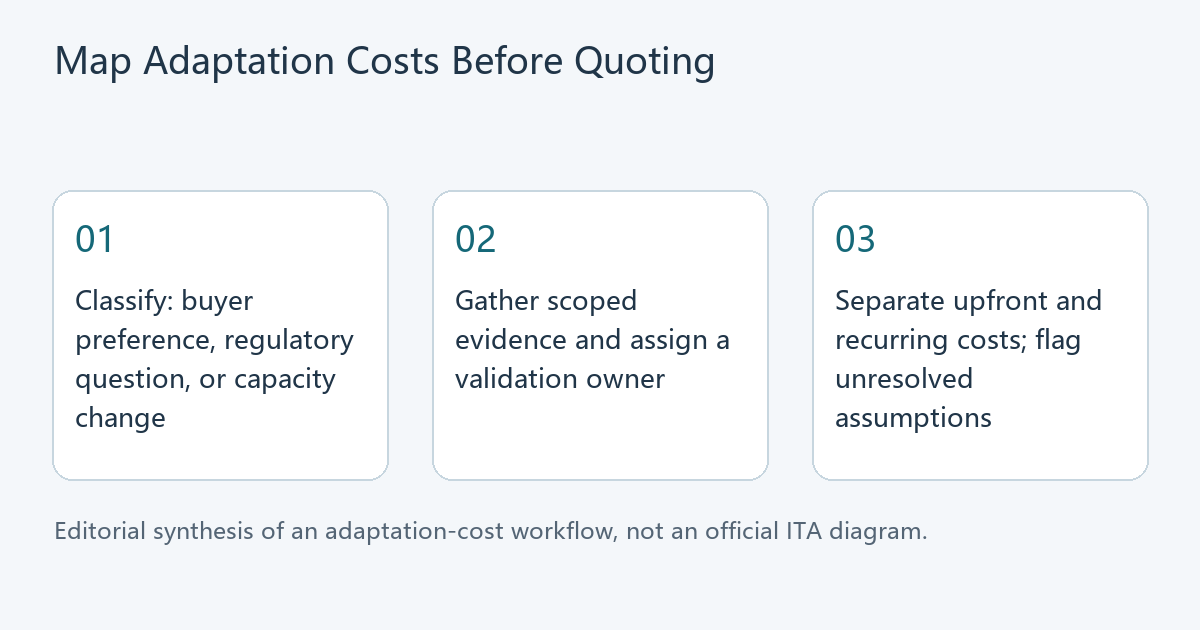
Before quoting for another export market, separate proposed adaptations into three groups: buyer-preference changes, regulatory questions, and production-capacity changes. Then record the evidence, cost timing, and person responsible for validating each assumption. Keep unknown costs visibly unresolved rather than treating them as zero.
This worksheet is an editorial planning method for established exporters comparing a new product configuration with one they already manufacture and sell abroad. It is not a country-specific compliance determination, accounting standard, or profitability forecast.
Separate the reason for changing the product
ITA’s assessment for exporters expanding into new markets asks about production capacity and the ability to modify ingredients and packaging. It notes that additional space, equipment, and financing for modifications may be needed. Its assessment for experienced exporters likewise identifies buyer tastes and foreign regulatory requirements as possible reasons for product changes.
Those are different questions. A buyer’s requested package size is not, by itself, evidence of a legal requirement. Equally, a familiar specification from an existing destination is not evidence that the same configuration meets another market’s rules. Keep commercial requests and unresolved regulatory questions in separate worksheet entries, even when both concern the same label or component.
A cost-question worksheet
The classifications and proposed validators below are editorial synthesis, not an official ITA form. They identify questions to investigate, not costs or requirements known to apply.
| Change category | Cost question | Evidence needed | One-time versus recurring | Who validates? |
|---|---|---|---|---|
| Buyer-preference product change | Would a requested feature or formulation change materials, development work, or assembly? | Written buyer specification; approved sample; supplier and engineering estimates. | Possible development setup versus materials and labor per unit. | Buyer confirms the request; engineering and purchasing validate feasibility and estimates. |
| Commercial packaging change | Would a preferred size, design, or pack format require separate tooling or stock? | Buyer-approved artwork and dimensions; packaging quotation; proposed order quantity. | Possible artwork or tooling setup versus packaging, storage, and order-level charges. | Buyer, packaging supplier, and operations validate their respective assumptions. |
| Regulatory product or labeling question | What modification, documentation, or assessment expense remains unconfirmed? | Applicable official rule and product scope; written applicability review; scoped provider quotation. | Separate initial work from any confirmed repeat, renewal, or change-triggered expense. | Qualified regulatory specialist validates applicability; relevant providers validate quoted work. |
| Production-capacity change | Can the adapted version fit the existing schedule without additional resources? | Production schedule; process assumptions; equipment and labor estimates. | Possible equipment or setup expense versus operating labor and maintenance. | Production and engineering validate capacity; finance reviews funding assumptions. |
| Training and after-sales adaptation | Would the revised product need different instructions, training, parts, or repair arrangements? | Support specification; distributor responsibilities; service-provider estimates. | Possible initial content preparation versus ongoing training, parts, and service. | Technical support, the distributor, and finance validate scope and responsibility. |
ITA’s foreign regulations overview explains that documentation and product requirements vary by destination; additional testing, labeling, or licensing may be involved. It does not establish which obligations apply to your product. Leave the regulatory row open until product-specific applicability is resolved.
Make estimates comparable
- Fix the baseline. Record the existing product version, packaging, batch assumptions, and production process. Compare every proposed change against that same baseline.
- Record the cost driver. Label each estimate per unit, per order, per batch, per period, or upfront. A recurring expense is not necessarily a per-unit expense.
- Separate evidence from assumptions. Mark entries as confirmed, estimated, or unresolved. Include the supporting document’s date and scope, plus a validation owner.
- Prevent double counting. If a packaging quotation includes setup, identify that inclusion before adding a separate tooling estimate. Do not allocate setup across hoped-for sales without labeling the volume assumption.
- Keep responsibility visible. Record who pays and who performs the work. Buyer reimbursement is an assumption until the parties agree it.
Adaptation costs are only one part of a quotation. ITA’s export-sale guidance identifies sale terms, payment method, and taxes and tariffs as pricing considerations. Keep those transaction questions adjacent to—but distinct from—the adaptation worksheet.
Hypothetical example: one package, two questions
Suppose an existing buyer requests a smaller package for a new destination. Enter the requested size as a commercial change and seek approval of its dimensions. Separately, record an unresolved question about destination labeling. Do not describe a suggested label as legally required simply because the buyer proposed it. Ask production to assess the smaller format against the current schedule, and ask the supplier to distinguish setup from repeat-order charges. These are hypothetical investigation steps, not observed costs or requirements.
Also check whether the adapted version changes support responsibilities. ITA’s product export-potential guidance discusses training and after-sales support as considerations. A product-change estimate should not silently omit the support work needed to deliver that version.
When to refresh the map
Source check date: October 7, 2026. This article uses supplied, bounded captures of ITA pages, not a live availability check. No destination rules, supplier prices, or production results were verified. Refresh affected rows when specifications, applicable rules, quotations, batch sizes, support responsibilities, or sales terms change. Unresolved entries identify the next validation task; they do not establish that market entry is economical.

